Showing posts with label crocodile. Show all posts

Monday, 9 September 2013

The Gulf, Cape York and Moreton Telegraph Station

The dry season is the busy season in the tropics.  Thoughts turn to warmth and sunshine when the first hint of frost appears in our southern latitudes and Queensland usually springs to mind.

Now when you want to be sure of warm weather, it pays to go to north Queensland because Brissy and the Gold coast can have their fair share of winter chills.

I have now done three Gulf Tours and two Cape York Tours, with one more Cape York Tour to go. 

I have stopped promising blog photos to my passengers as I forget all the details by the time I get round to writing them.  

I made the following movie clip on my first Gulf Tour in June, so this is for my passengers in June.


Ian helped out at Moreton Telegraph Station doing boat tours on the Wenlock River, as the previous coxswain made a sudden departure due to family emergency.  


Ian (centre standing) cautiously navigates between shallow sandbanks on the Wenlock
Navigating the river was tricky as a 'dry' wet season caused a low water level much earlier than usual.  


There were usually a couple of trustworthy residents of the Wenlock River to show to admiring tourists.

This Azure Kingfisher looked particularly spectacular as he flashed his electric blue from branch to branch as he zig-zagged his way up the river.


                                                    A territorial Shining Flycatcher lets everyone know that this is his branch and to go and find your own flies somewhere else.      


Ian drove to Moreton, accompanied by 'Pete, the Plumber', who was also going to Moreton to help out for a few weeks.  He was promised lots of lazy days, relaxing and fishing for the numerous Barramundi which abounded in the Wenlock.  All he had to do was a tiny bit of work in return for his food and lodging. All Ian had to do was help Pete when he wasn't driving the boat.

After 2 weeks, Pete finally managed to do a bit of fishing.  He caught a Barra, among other things.


I returned from my Gulf trip and booked a flight to Moreton.  I would spend my two weeks off taking photos, while Ian worked.


Moreton airstrip boasts a no-frills terminal for the budget conscious. The mail plane comes once a week and you can even mail people to and from there.


A Yellow Honeyeater  picks some fruit and catches it


Moreton always has an abundance of wildlife, especially birds.  This kept me occupied while Ian was working.  I never get tired of stalking these Red-winged Parrots as they try and feed in the grass undisturbed.  This one eyed me off suspiciously. . . . 

unlike this Black-backed Butcherbird who showed off his grasshopper.


Ian did manage to get a couple of days off while I was there.  We went exploring around some nearby lagoons.  Ian had found this amazing tree a few days before I got to Moreton.  It turns out to be a Weeping Tea Tree.  


Melaleucas being friendly with the lagoon. 


A White-faced Heron poses for a photograph.


The day is done.  We have a cup of tea before retiring to our Safari Tent accommodation.


After a few weeks Ian and I drive  back to Cairns. The Wenlock is down to a trickle and boat cruises are finished for the year.  I have to do my next trip.  

Pete left a couple of days before us.  Fishing was getting too dangerous and nobody was willing to unhook his crocodiles for him.

The crocodile he caught in the movie clip was unhurt and managed to free itself.


Tuesday, 25 June 2013

The Return from Cape York

After farewelling my first tour group for the season, it was time to welcome the return group.  I didn't make the mistake of telling this group it never rains at this time of the year.


Judith castes a lovely reflection as she stands at the 'Tip' in the sunshine


After the 'Tip' we continued to Somerset and the sun followed on.  


Kay rested at the old well which is hidden behind the mangroves (look out for crocodiles)
The Somerset beach.


A bit of amusement occurred at Moreton when I tried on 2 occassions to enter the wrong tent.  Red faced I tried to make a hasty retreat from the gentleman's tent.  "Are you OK asked a concerned voice from behind another tent."  "No", I said, "the zip's stuck".
Wrong thing to say!


 While my group were doing a Weipa Mine Tour, I did a few tour guide related chores, then waited at Albatross Bay for their tour to finish.

There is usually some interesting bird activity going on and today wasn't any different.

I watched this Egret doing some fishing, using an unusual tactic - he seemed to be listening for the fish.


Then I got too close -  and yes, he flew away.  Funny thing though, he kept his neck outstretched for the first few wing flaps till he kinked it in true Egret style.  He looks all neck and legs here.


Then I found this Striated Heron fishing using a different style. 

                 This was a more concentrated killer look.


And it worked.  A fish in the beak is worth two in the sea.

We headed down the Cape and called in to the Batavia Gold Fields ruins.  In the early part of the 19th century, there was gold in them thar hills.  Heavy machinery was brought in to crush the gold bearing rock in order to extract it.  It took teams of 60+ bullocks to drag the machinery in and many months to get it there.  When the gold ran out, the machinery stayed put to slowly rust away.


Some of the old machinery from the gold mines.  The Batavia Fields had several ups and downs in the search for gold and was finally given up on around WWII.


 Helen contemplates the feasibility of repairing this vehicle, while Judith looks sceptical.  No-one has ever worked out exactly what make this vehicle is but one smart remark suggested that it was an Oztours bus (gotten lost). 


Now during this tour, as in most others, there is usually at least one person who really wants to see a crocodile.  The chances of seeing one are inversely proportional to the degree of wanting to see one.

I didn't like the chances.  There was one glimmer of high possibility.  Musgrave!

A couple of 'freshies' might have been put there on purpose

After arriving at Musgrave and putting our gear in 'the right rooms', we headed down to the billabong.

Nah, they weren't there - at first glance.  Then someone spotted a little snout.  Hooray, it was there.  OK, not a 'saltie' but very photogenic with the still water providing a reverse image below the croc.


There is always a good show of flowers in the gardens of the Musgrave Telegraph Station.  I was happy to get a shot of these late blooming Cooktown Orchids.


We were getting close to the end of our trip with Lakefield National Park being the next on our agenda.  I made everyone get up and packed early as there is a lot to see on this leg.


There is an area in Lakefield called Nifold Plain.  There are no trees at all over a large area, only magnetic termite mounds.  This gives the are an eerie moonscape feeling.

A Brown Falcon watches us from his guide-post perch.  


Lilies abound in the many waterholes throughout the Park.  On the right is the tiny Snowflake Lily which can be easily overlooked till pointed out.  The petals 'zip' together when the flower is submerged under water.


There is an enormous lagoon called Red Lily Lagoon which is completely dominated by these beautiful red Lotus Lilies Nelumbo nucifera .  


These Scarlett Gums can be found along the southern end of Lakefield along Battlecamp Road.  They grow across northern Australia and in a small area between Cooktown and Laura.  


Our last stop before Cooktown was Isabella Falls.  I waited patiently for a car to cross the causeway for my next photo.  Soon I was rewarded with an obliging driver who wanted to know how fast I wanted him to go.  "It's up to you", I said.  "If you want an action photo with water spraying everywhere, go fast.  If you want a nice photo  with a reflection, go fast."

The driver was a man, so he went fast!  


                            The following movie goes for 1m:39s 


Tuesday, 6 November 2012

Cape York - "The Tip"

Wed 31 Oct.  We hired a "Limo" for  our trip to the tip.  It was a Toyota Landcruiser troopy. None of that looking around the car for scratches and minor dents that you don't want to be blamed for later on.  We would have been there a week listing them all.

After using a crow bar to adjust the door so we could close it, we were off.  There were 8 of us in all and we could all fit in this vehicle and apart from hoping that it would make the distance, that was all that mattered.

I made this movie clip of our trip.  It takes 4 mins 16 secs.  I've resized it to email quality - 46.6mb


As usual, the main topic of conversation between us and the other yachties was the weather, especially wind speed and direction.  Bob and Cheryl had to get back to Cairns for work commitments and left the 2 Nov, bad winds and all.  The rest of us stayed put - no point in punishing ourselves and our boats if we didn't have to.  As it turned out, Bob and Cheryl haven't had too much of a rough trip so far, but they have sheltered for a couple of days at Portland Roads for the worst.

Ian had been busy fishing and I have lost sleep over it.  


  • Ian gets up early
  • I can't focus and go back to sleep
  • Flippity flippity flap flap flap
  • What the ? ? ? ?
  • The world comes into focus for me
  • IANNNN are you fishing?
He is catching sardines for bait for bigger fish which he catches but they are too big and break the line before he can bring them in.  

We do a fair bit of walking to get ourselves fit again.  The jetty is always a hive of activity as the locals manage to supplement their food supplies there very well.


Locals catch fish by the bucket load from the jetty.


Wayne gets some tips from the kids on the finer art using a cast net.


Barbara in front of a termite mound.

Barbara and I do a long walk.  Our waistlines are steadily approaching the dimensions of our boat's waterlines from too much food and too little exercise.

We go bush for a while so I can go looking for birds while Barbara looks for new plants - she has a background in horticulture and is a wealth of information when I need to know what a particular plant is that I've never seen before.


Proiphys Lily

This beautiful scented lily emerges after the first rains of the wet season.  Few people get to see this lily as most visitors have left the Cape at this time of the year.


I spot a Red-backed Fairywren, in all his feisty glory.  He is fiercely protective of the grasshopper he has just caught and dares me to try and take it from him.


Red-backed Fairywren


Native Spider Lily


This eye-catching Native Spider Lily is another flower which emerges at the onset of the wet season.  The bulb can be dug up, ground and boiled and then applied as a "painkiller, disinfectant and insect repellent all in one".


The next day, a few more people join us in a walk to Red Island which is just a stone's throw from Seisia.  Ian and I attempted to visit this island not long after we arrived here but we chickened out when a crocodile jumped into the water from the beach we were about to land on.  

We decided there was safety in numbers and ventured forth.


Bees visiting a Scarlet Flowered Bloodroot 

We found this attractive little plant growing across the island.  Once again, it heralds the wet season - nature is telling us something!


After consulting John Beasley's 'Plants of Cape York' once again we find that it is a Scarlet Flowered Bloodroot.  Named for the red sap of the bulb which is used as dye by Aboriginal people for baskets and bags. 


On a less happy note, Ian finds a discarded fishing line lying in a tangle, complete with a bird skeleton.  It must have been a slow and cruel demise for the unfortunate bird that met with the careless action of a fisherman.
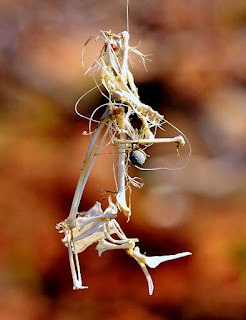


once was a bird


A pigeon pair

On a happier note - a pair of Pied Imperial Pigeons also known as Torres Strait Pigeons.  These beautiful birds migrate to the north of our continent from New Guinea each year to breed.


There are enough yachties here now for a game of cricket with the arrival of a couple more yachts.  Ian finds a splintered plank on the beach and fashions it into a cricket bat.  A lot of insulation tape applied over the lot to prevent splinters and it's ready to go.  Wayne and Barbara had a cricket (tennis) ball and we used jerry cans as wickets.  A concrete path running parallel with the beach proved to be a great pitch.

After a couple of dismal bowls from our participants, we accosted an innocent passer-by. 
 "Can you bowl?", we asked the hapless stranger.
It turned out he had played cricket for Townsville and Brisbane and was quickly enlisted in our game.  

All went well for a while till someone spotted a crocodile cruising close to the beach.  The cricket rules suddenly had a new one. If you hit the ball into the water, you had to go and get it yourself.

We are itching to get going as usual.  The weather patterns are unusual and we can't seem to find a good break.  Seisia is a good place to be as everything (shops, water, fuel, showers and washing machines) are in walking distance and it is only a short distance by dinghy to the shore. There are good beaches and bush walks to go on as well. 

On a longer walk, you can get to Bamaga which is about 3/4 of an hour by foot.  On the way to Bamaga there are sewerage ponds.  I bet that excites all my readers!  Well, we noticed a lot of ducks there the other day and I'm hoping to 'spot' some Spotted Whistling Ducks.  I suppose that would make them 'double spotted'.

There are also pockets of monsoonal rainforest in which reside Magnificent Riflebirds (one of Australia's 4 Birds of Paradise).  I heard them the other day as we were walking past.

Ian hasn't seen any more Palm Cockatoos and is now appreciating the sighting earlier in our trip.  If we have to wait at Seisia for much longer, the Beach Almonds which grow near the jetty, should ripen.  Palm Cockatoos love them.

Well, it's off to the showers for now.  Amusing signs on the amenities ensures that Ian and I go into the right ones.


Thursday, 27 September 2012

Crocodiles, Banteng and Buffalo

We left Darwin around midnight on 12 Sept so we could go with the flow of the tide.  

We anchored at Alcaro Bay near the Cape Don lighthouse the following evening.  

We decided to spend a day.  There was a 5km walk from the jetty near where we were anchored to the lighthouse which amounted to 10km there and back but we were up to it and it would be worth it!

We armed ourselves with cameras, lollies and water and grabbed our best thongs for the walk. Ian also took his spear gun in case we had to defend ourselves against crocs.  

We landed on a nice little spot on the beach away from where crocs were likely to be lurking.  We got about 10m along the beach when we noticed a rather fresh croc slide.  

We looked around nervously and wondered what we should do.  Ian knew.  He went and got a nasty looking stick to back up his spear gun.  

Another nervous look around and we made our way to the track on the high side of the beach.  We left our armoury at a convenient spot at the start of the track to be collected for defence purposes when we came back.

Well, we walked and walked and walked.  The day got hotter, our lollies and water started to run out and our thongs were proving to be unsuitable.

Several times Ian questioned whether we should give up and turn around but I assured him that the lighthouse would be just around the next corner and it would be worth it.

In the finish, it just wasn't worth it and we turned around minus the lighthouse experience.   

We made it back to the jetty before heat exhaustion and fatigue overcame us.    
Ian retrieved his weapons.
A thorough scan of the area didn't show up any further evidence of crocodile activity so we quickly launched the dinghy and sped back to Winkali as fast as our 3.5hp outboard would go.

We survived!


Trusty assistant catches a Golden Trevally


That evening we thought a change from Spanish Mackerel would be welcome on the menu.


 The following morning we left for Port Essington which is at the top of Coburg Peninsular.  Our first anchorage was at Black Point which boasts a boat ramp, ranger station, cultural information centre and, best of all, a swamp where many birds congregate.

This was a great place to bring the cameras to.


"Look out, George is coming in for landing"

Magpie Geese sporting an orange tinge from the red soil in the swamp.


Practice makes perfect - keep practising George.


We were treated to the sight of Magpie Geese taking flight in a shower of diamonds as we approached.


 We noticed that the edges of the swamp had been disturbed and muddied by many hooves.  Usually the cause of this in Northern Australia is pigs but in this case it was from cattle.

The information centre told us that these were Banteng cattle which were brought to the Coburg peninsular in the early 1800s when a township named Victoria Settlement was established in the area.  This settlement was abandoned after 10 years due to the harsh environment and sickness etc.

A small herd of these cattle were left behind and now form the largest herd of wild Banteng in the world.  They are almost extinct in the wild in their home lands due to loss of habitat, although there are many domestic Banteng cattle still in Asia.

Although we saw many hoofprints and cow-pats, we saw no Banteng.


One of the rangers walking home after a hard day in the office
 The beach offered more exploring so off we went in that direction.


The beach took on a different look at every turn.


Everywhere we went there were amazing rock formations. These rocks looked good enough to eat - creamy vanilla with boysenberry swirls - yum!


Still in Port Essington, we ventured to Kennedy Bay the next night.  Another exploration along that beach showed more evidence of Banteng. 

Ian considers whether he should keep this buoy.
Let's see how it bowls.


Even better, Ian found more treasure.

Our last stop in Port Essington was 7 Spirit Bay.  This was a beautiful spot complete with a 4 star resort.  As there were no roads into this bay, access was by boat from the rangers station at Black Point or by plane as they had their own little airstrip.

The resort managers were very friendly and we were allowed to use their facilities as well as take a good wander around for a modest fee.

More swamps, we were in our element.


And so were the crocodiles.  This is a photo of one of the numerous slides which were side by side along the whole beach.
 In the distance we saw what we first took to be a termite mound. . . . . . .


 until it stood up. . . . .


and was joined by its friend who had been hiding in the shadows.


 We had nowhere to run to.  Ahead lay the bovine enemy, in the water, ugh, I don't want to think about it.

We retreated.


A moving line in the water made us think of crocodiles.  After a bit of focusing and zooming of camera lenses we were astonished to see it was a line of fish, skimming the water with mouths wide open.  

A thorough search of Grant's Fish Guide hasn't shed any light on what kind of fish this might be.


 Another blog coming soon.  This one's getting too long.

See you there  :)